Temp ranges 0-100 in real life in temperate, North America. This is also about what the human body perceives as “really fucking cold” and “really fucking hot”.
What do they span in Celsius? Probably some easily divisible decimals that are just as easy to understand if you’re used to them. Because Celsius is a scale not relative to weather, but rather to water. Which is sciency, but not weathery.
Farenheit doesn’t “intuitively” tell you whether there’s going to be ice on the road or whether your pipes are liable to freeze, and also has the added pain in the ass that on a very hot day you need 3 digits to represent the number instead of 2, and doesn’t even compensate for it by removing the possibility of negative values which can still also happen.
On top of that the extra scale doesn’t give you a perceivable difference between the numbers, that is to say, I could put you in a room and ask you if it was 70F or 71F and you’d basically be guessing.
Celsius on the other hand is eminently relatable: negative number means ice/snow, single digit means heavy coat, tens means lighter coat/sleeves, twenties means nice, thirties means hot, forties means remain indoors.
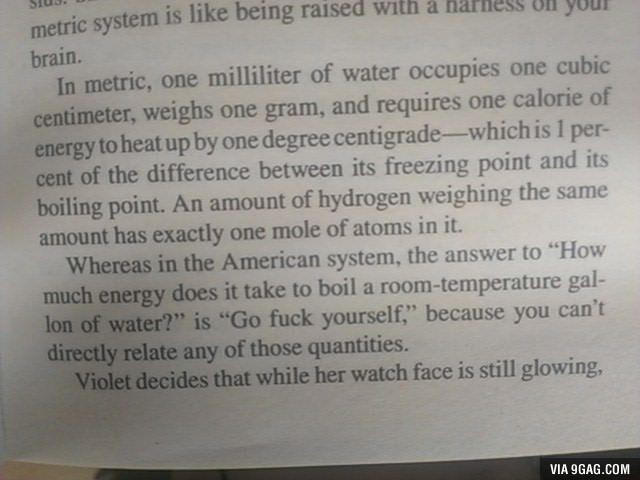
You’re right, the Celsius scale doesn’t span across one particular ‘topic’- but either end point is not only relatable, but specific. You’ve got snows/frosts/freezes at one end, and boiling at the other. Both of those will always happen at that temperature (more or less), but different people will feel comfortable or not in a hugely wide range.


Temp ranges 0-100 in real life in temperate, North America. This is also about what the human body perceives as “really fucking cold” and “really fucking hot”.
What do they span in Celsius? Probably some easily divisible decimals that are just as easy to understand if you’re used to them. Because Celsius is a scale not relative to weather, but rather to water. Which is sciency, but not weathery.
That doesn’t even stand up on its own terms.
Farenheit doesn’t “intuitively” tell you whether there’s going to be ice on the road or whether your pipes are liable to freeze, and also has the added pain in the ass that on a very hot day you need 3 digits to represent the number instead of 2, and doesn’t even compensate for it by removing the possibility of negative values which can still also happen.
On top of that the extra scale doesn’t give you a perceivable difference between the numbers, that is to say, I could put you in a room and ask you if it was 70F or 71F and you’d basically be guessing.
Celsius on the other hand is eminently relatable: negative number means ice/snow, single digit means heavy coat, tens means lighter coat/sleeves, twenties means nice, thirties means hot, forties means remain indoors.
Lol no
US temps (°F), roughly:
NE / Midwest - winter 15-35, summer 70-85 Northern Plains - winter 0-25, summer 70-85 Southeast - winter 40-65, summer 80-92 Desert SW - winter 45-68, summer 95-110 Pacific coast - winter 40-58, summer 60-78 Alaska (inland) - winter -20 to 0, summer 55-72
Celsius in comparison
OC…water freezes, 100C water boils
You’re right, the Celsius scale doesn’t span across one particular ‘topic’- but either end point is not only relatable, but specific. You’ve got snows/frosts/freezes at one end, and boiling at the other. Both of those will always happen at that temperature (more or less), but different people will feel comfortable or not in a hugely wide range.