

1·
2 months agoKeep pushing to advertise it and I’ll have more work, thanks.
Keep pushing to advertise it and I’ll have more work, thanks.
For a layperson, you are unbelievably, stubbornly confident in your incorrectness. You cannot possibly know the depths of your ignorance. I am an expert, and I will continue fixing the problems caused by bad international dentistry for a healthy fee. You don’t need to believe it for it to be true, and your denial does nothing to change my daily reality in practice. Good luck.
With all due respect, you don’t know what you don’t know. In case you missed it, I am a US dentist. I spend every working day dispelling laypeople’s misconceptions about dental work. What work they have, what work they need, benefits and drawbacks, etc. Your post hits on some of the many very common misconceptions.
Fortunately, there are plenty of ways to check the efficacy of medical procedures.
You can get x-rays, MRIs and all sorts of after-care examinations performed by your choice of trusted doctors and dentists if you are unsure of the quality of care you received.
Not all work can be evaluated, even with x-rays, as restorative materials often hide the most important details. MRI is irrelevant for dental. X-rays are just a tool, not the final word, and they can’t reveal certain things. Bacterial ingress and leakage is, for all intents and purposes, invisible. Most docs (in both medicine and dental) are exceptionally reluctant to disparage another’s work. It is considered unprofessional and unethical to bad-mouth another professional. That’s just how we’re trained.
A strong indicator will be how you feel after the procedure, which is why I include patient surveys in all of my posts about medical care abroad. Very importantly, other than the higher-rated equipment, expertise and report accuracy, patient satisfaction regarding care quality in Thailand is rated higher than in the US, for example.
This could not be further from the truth. Discomfort and success are completely different things. Some extremely high quality, ultimately-successful treatments will make you feel like shit afterwards. Often, post op symptoms are more closely a matter of chance than they are of quality. Patient satisfaction and surveys are complete worthless bullshit, as evidenced by hospitals’ Press Ganey scores, etc. See Goodhart’s law. Docs hate chasing patient satisfaction because it is so poorly correlated with actual quality care. Telling the patient “no, this will have a poor outcome” gets you bad reviews, while doing a slipshod job that is unlikely to last but looks superficially good gets you patient satisfaction. I see it CONSTANTLY. Smooth-talking, kind-seeming, gentle dentists whose skills and ethics are complete trash. Patients can’t tell the difference. This is why so many people love Nurse Practitioners, who are poorly trained and often happy to act as a rubber stamp for what the patient is asking for, even if it is not in their best interests. People love “yes men”.
Remember, Yelp and Google reviews are both astroturfed by business owners, and used as a weapon by disgruntled people and competitors alike. There’s a local dentist office that’s still under construction and it already has 30+ 5-star reviews in Google. Hasn’t seen a single patient yet. I would not be too trusting of reviews in general.
You have taken your subjective experience and tried to use that to say the work is objectively good. That’s not how any of this works.
Now could that work actually be good? It could be. This is not to say that all foreign dentistry is bad, but SO MUCH OF IT IS. I know because I see it. The fact of the matter is, patients generally don’t know the difference between good and bad work. I see patients all the time who said some absolute basement-tier-garbage work was done by their previous dentist, who they adored.
Incorrect. This applies to most medical care destinations outside of the US; follow-up care is essential abroad and is usually presented in a contract and verbally confirmed with you before any diagnosis even takes place, let alone a procedure. You have access to all the documents and files your hospital abroad does and are also free to share those or ask your hospital to share the documents with other doctors and clinics of your choice.
Ask any orthopedic surgeon what they think of foreign procedure mills offloading post-op knee-replacement care to an unfamiliar doc in the country the patient is visiting from. This is a huge issue docs discuss in private - patients flying to wherever for cheap, substandard treatment and leaving them to manage the complications. It’s a big issue in places like FL and NY, but also broadly everywhere.
Many treatments, you get essentially one chance to get it right, and fixing it is either impossible or 10x as much difficulty. Getting it right the first time is priceless. You can fuck up a tooth in an instant. Destroyed. Cannot be fixed. Some errors are invisible and don’t hurt right away. Many infections are painless or hard to diagnose from typical x-rays. Many compromised teeth spend a few years feeling normal before they fall apart. I know this because I see it every day. I’m the one who gets to fix others’ mistakes - if they can even be fixed.
As a practicing professional who spent the majority of my training seeing a high % of international dentistry, it’s hard to watch.
Dental work is my most common healthcare experience abroad. I cannot recommend Thailand enough, especially for dental work, nothing but 5 out of 5 dentistry for me so far.
What it all boils down to is: how can you know the work done was good? You can’t. You can know it looks good superficially. You can know the dentist was nice, or that their office was clean, and that the bill was low. You can’t know if the work is actually good. You don’t know if they are intentionally overlooking long-term health for doing what the patient/customer wants right now. You don’t know if the materials or techniques would be considered substandard in the US. Yes, other countries often have a different “standard of care”. I have seen ABYSMAL work from Asia and the Middle East. I have seen appalling work from Mexico, Central America, and Eastern Europe. Yes I also see bad work done by local US dentists - primarily those who advertise themselves as being some kind of affordable, emergency, or discount office – but consistently the worst dental treatment I see is foreign. How do I know? I’m the one who has to fix it, if it can be fixed.
Dental tourism scares the hell out of me as a dentist in the US, but I understand why it appeals to people when quality care here is expensive. I have seen bad work from every country in the world, including the US, but the trend is you largely get what you pay for. The offices that accept every insurance under the sun are doing work at discounted fees, and usually cutting corners to do more of it. Medicaid? Pays less than the cost of providing the service unless serious corners are cut. Those are the US-side problems, but the dentists working for poverty wages in India are doing much worse things, on average.
Why is it often worse? With dental tourism you get no follow-up care. You also have no recourse if they fuck up your mouth. Good luck suing a dentist in Mexico or Thailand for malpractice. Turns out, the more financial incentive you have to practice high-quality care, the more you have to lose from fucking up and losing your license.
EDIT: This is “Work Reform”, not “Fuck Everyone Who Has More Skills And Makes More Money Than Me”, although you wouldn’t know it from the types of responses sometimes. Quite frankly dentists are workers, whether employees or practice owners. They only earn what the work of their hands allows. They are not exploiting other workers to do the billable labor, because legally they cannot allow non-dentists to do the vast majority of billable work (there are small exceptions that account for a tiny % at most practices). They are not capitalists. The downvoters just hate the message and would rather shoot the messenger than listen to someone who knows from the inside.
All this boils down to is that there is nothing more expensive than first-world human labor. Without a doubt, nursing homes are increasingly run by sleazy profiteers, but the reason you can’t easily do better (i.e. find a high-quality nursing home) is because it’s simply expensive to employ enough people, who have sufficient skill and work ethic, to give the elderly care.
Yes, PE in healthcare is destroying the country in every imaginable way. The answer in this case is more complicated than get the for profit companies out of nursing homes, which is necessary but not sufficient to solve the problem. The scariest thought is that there may be no good solution.

That’s what I’m talking about also. Experts who are being paid to express an opinion, but in a circumstance where their peers would hold a consensus opinion that opposes what they are stating in court. Those experts are mercenaries.
That’s a good way to put it - it’s laziness. Maybe it’s laziness though the burden of history where the structure of the system is cobbled together from hundreds of years of increasingly irrelevant procedures and precedent that can’t be modernized with society. I’m not a legal scholar by any stretch, but the whole thing looks suspect to me.
I’ve heard from medical experts that appear not to be mercenaries, but my issue is that there’s no way for the legal system to distinguish between a person who takes the job only when they’re on the right side of an issue, and a person who will craft an argument to make their side seem right regardless of the facts. The process all seems very corrupt from the outside. It incentivizes financial conflict of interest.
That’s the issue I have with the justice system - it’s much too loose with facts because it’s designed around persuading non experts (and arguably jury selection is designed to reject people with high education or relevant background knowledge). The adversarial process gives each side an equal go at persuasion even if one side doesn’t have a leg to stand on scientifically. The judge isn’t in a position to disallow something that would be considered bullshit to an expert, and any qualified expert is allowed to sell out and present a biased interpretation of facts, even if 99% of their peers would disagree. More often than not, your resources determine whether or not you’re right in the eyes of the law. It’s bullshit.
Edit: if you’re a physician on trial for malpractice, “A jury of your peers” would consist entirely of physicians in your area of practice, as they are the only people with the relevant understanding and background knowledge to evaluate whether your actions followed the standard of care or constitute malpractice. The fact that courts don’t operate this way means that findings of guilt or innocence are basically a popularity/debate contest with a veneer of authenticity.
Believe me when I say I’m not on corporations’ side and I think they get away with all kinds of immoral shit through craftiness in the legal system, but I think that the only intellectually honest answer is that suspicious linkages are not causality, and that it should be evaluated by someone wielding scientific impartiality and robust statistical and epidemiological methods, rather than a legal process. Unfortunately courts are a shit place to evaluate science or broadly reality.
PFOA and similar precursor chemicals are one of those areas where I think it should be easy to establish elevated risk of disease with epidemiology (they probably have, but it’s not my field and I haven’t looked), but there are a lot of other areas that are much less clear cut. I’ve seen firsthand the family’s emotional response to cancer being to find a villain somewhere, and it was in a case where I think no villain ever existed. People behave irrationally with mortal disease, and unfortunately some of it is just bad luck.
That’s interesting, thanks.
I don’t mean to seem disrespectful of the loss of your relative in any way, but how were you able to establish a causal relationship between the CPAP machine and a particular illness or death?
It’s not a question based in some sort of absolvence-by-legal-technicality, but I often read accounts of grieving family members who “just know” that that MMR vaccine caused their son’s autism, or that dad using a chemical occasionally in the garage “must have” caused his cancer - because it’s less scary than the idea that bad health problems happen at random to people who didn’t do anything to cause it.
Edit: rarely, some health condition leads to a smoking gun, but most do not. Mesothelioma is only caused by exposure to asbestos, which is why you see commercials for lawyers seeking plaintiffs for injury cases. The causal relationship is established.

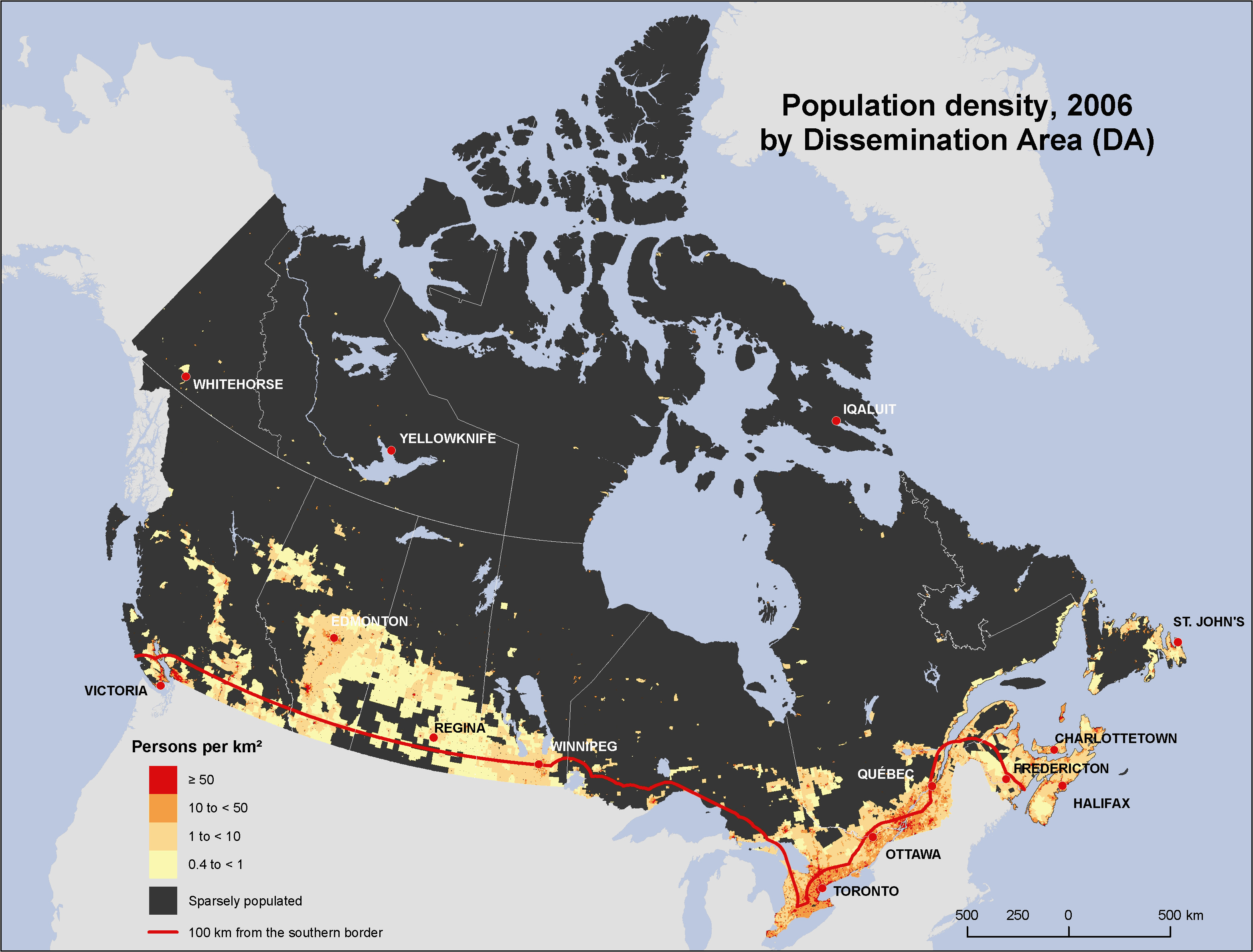
There’s a lot of land in North Dakota as well. It’s super flat, boring, and winters are ultra cold and windy as hell. There are very good reasons it has a low population. It’s further south than most of the places in Canada you’re talking about.
EDIT: I’d like to add that “we’re not overpopulated, there’s plenty of land!” isn’t really the whole story, either. Occupying every square mile that can be occupied should not be a goal. Leaving more places in a natural state without human impact is highly desirable, IMO.
Huge areas of Canada are at high latitudes and very dark, cold, and inhospitable in the winter. Something like 50% of Canada’s population lives south of the northern extent of the US (i.e. south of Seattle, the Upper Peninsula of Michigan, half of MN, and almost all of MT/ND.
Huge areas of Australia are desert.
The population distribution of Canada and Australia is not an accident. The coasts and more temperate climates are much more hospitable.
It sounds like we generally agree that there are structural reasons quite aside from population growth, and agree that they desperately need to be addressed (i.e. regulatory). I’m arguing from the perspective that we should absolutely attempt to address these reasons, but that ANY population growth from any source is essentially adding fuel to the fire.
I think a lot of emphasis gets put on “supply-side” solutions that sound a lot like “just build more houses, NBD!”. From what I’ve observed we can’t get there with the existing land without (IMO) excessive densification and/or sprawl which has an easily-felt deleterious effect on livability. I’ve spent the last couple of decades living in very different places, and watched them change due to growth. In all cases growth has caused traffic that never existed before, MASSIVE crowding of local attractions that can’t be mitigated without restrictive permitting, and astronomical increases in the price of real estate. Without being hyperbolic at all, more population has quite literally been felt as less freedom. Some of this is due to the rise of the global middle class, but they have their hands in my home places at the expense of locals, and it’s gone from great to hellish in about 20-30 years.
The problems with new housing seem to be:
Like if you think you can find 10 million people to give up LA/Seattle/NY/etc and move to central Kansas, where there’s no ocean, no mountains, no lakes, no jobs, and nothing to do, more power to you. People live in interesting places for good reasons, and other places are cheap for good reasons.
An adjacent point: nature abhors a vacuum. If the QOL is better in the US and there are ~8 billion possible candidates for immigration, our population could easily double in a month. The demand is there. We could adopt a policy of open borders until QOL reaches equilibrium at some much lower level and immigration stops - we could also make immigration virtually impossible - or anything in-between. I’m of the opinion that lower influx means > QOL pretty close to 100% of the time.
EDIT: tl;dr - more individuals translates to reduced individual freedom. I’m not going to get weird and libertarian about it, but that’s the relationship I observe.
I appreciate the data-supported arguments but the comment on doubling was a stated goal of the Canadian national government. The Canadian population is presently projected to double in 26 years. Geographically constrained places with high immigration like Australia and Canada are shockingly unaffordable right now. These places are the canary in the coal mine for the US, which may have plenty of usable land on paper, but has the same issues with a self perpetuating cycle of the major metro areas having all the jobs and limited room to grow. The population is up 50% in my lifetime and I think that accurately reflects real estate becoming increasingly unattainable.
Edit: I guess what I’m saying is that housing-as-investment is wrong, but the basis for housing-as-investment (and indeed all investment) is the projection of increased future demand. In developed nations, this comes from immigration. If the population were shrinking indefinitely, housing certainly wouldn’t be increasing in value
That was a different time before a reasonable house in a major metro area cost $500k-$1m. Capitalists want endless population growth forever to make their investments go up, and the only way they can get it in educated nations with low birth rate is immigration. Canada explicitly targets it. The population is doubling at the expense of affordability. I’ll never be able to afford a house because everyone wants to live here, and immigration policy is set by those who favor endless growth.

I suppose it could be opt in for the end users - say they host the communities they participate in only (i.e somebody likes 3D Printing and coffee, but maybe not porn or politics).
I’ve been arguing that Lemmy needs to become distributed a la BitTorrent to be sustainable. If regular users are participating in small pieces of hosting so that it’s completely decentralized and load is taken off the instance servers, it would be sustainable.



Yes, but what about Bubb Rubb?