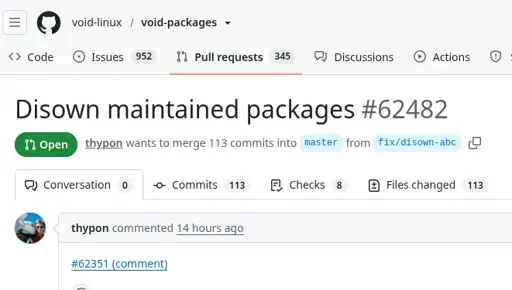
Valid position from the Void side AND valid crashout. I’m impressed. A distro absolutely can use policy to enforce a vision to be AI-free on the contributions, and a maintainer can quit if they don’t agree with the distro vision
I agree.
Leaving so abruptly may not be the classiest move but it’s not like one can’t leave if he so decides.
The dev will be fine and so will void. Nothing to see here for now.
You know what has never benefited any of us here? Private jets and yachts.
the butlerian jihad begins
Good riddance.
Do not bring AI review tools into pull requests.
As someone who operates an internal AI code review platform for a large engineering org. Trust me, you want this.
There are countless defects that regularly slip by human review. It’s one of the few places that AI adds immediate, low-risk value.
That aside, though, this is unfortunate. And the author and maintainer of these packages is entirely within their rights to do this as a form of protest.
Absolutionist policies aren’t helpful.
Sure, maybe it’s fantastic at reviewing PRs. I could imagine that. But
Trust me, you want this.
is pretty condescending, implying those against it haven’t thought it through. I personally could list about twenty reasons for not using AI, many of them infinitely more important than code being well reviewed.
Having used these at my day job I can understand the policy against them. Ours is fairly well tuned by the people who operate it, adapted to our codebase, and its comments are usually on point, but its false positive rate for my own PRs is still in the low double digit percent range (feedback that’s factually wrong, not relevant to the PR, not scoped appropriately, etc). Before all that tuning, back when we first started using it, I probably went days or weeks without seeing a well-founded suggestion from the tool. Incorrect comments still create work for the PR author (investigating, double checking, etc), they create noise for human reviewers, and ambiguity about whether a change is ready to be merged. I read that policy as being against random people pointing their own review tools at PRs for this project, which I assume would be more on the high false positive/high noise end of the spectrum (i.e., not being tuned for this specific project). I can totally see why already busy maintainers would want to spare themselves from a bunch of poorly calibrated noise.
One nice thing about them compared to human reviewers is that you can just tell them to (professionally) fuck off if they’re wrong without hurting their feelings or having an HR conversation.
I’m not saying you are wrong (not saying you are right either), but… your comment sounds a lot like “trust me, I have a conflict of interest” :)
Here the pull request and discussion:
https://github.com/void-linux/void-packages/pull/62351#issuecomment-5641804457
Changes not tested.
Trust me, nobody trusts you.
That’s a great way to alienate people who are trying to start discussions. Good job.
Do you have the expertise and experience to state what is or isn’t important for PR change review? The data to back up defect rates and outages?
If not, then you’re just speaking out of your ass and with your emotions instead of with logic.
What if the goals of reviewing a PR in Void Linux are different from the goals of reviewing a PR in your org? Are there any possible goals you can think of, where introducing an AI tool would actually be detrimental?
if i have to trust you then doesn’t that kinda show why the technology isn’t particularly useful? Surely it should be able to speak for itself, rather than need you to vehemently insist that “actually it’s really good you guys just don’t get it”.
I’m referring to PR review specifically. Do you not know what PR reviews are?
Sorry, but what does AI achieve that static code analysis tools don’t? Apart from maybe ridiculous environmental impact?